



students
certifications
The Need for a Multi-Site Solution
For more than 20 years, UPEC has been committed to a structured quality assurance approach. With 7 certifications already obtained and 4 currently in the process of being obtained, the university must build on its achievements and promote quality-related practices. The diversity of our academic programs and the geographic distribution of our student body (across 16 campuses) make it essential to provide a collaborative, cross-functional, and centralized tool.
“With an organizational structure typical of a higher education institution, UPEC operates in a complex manner. It is often difficult to assess the progress of our quality initiatives and whether we are meeting our predefined objectives. In this context, using tools to guide our efforts has become absolutely essential.”
Before: A siloed approach to quality management
Prior to this, the monitoring and implementation of our quality initiatives relied on Excel and related office software and were specific to each operating unit. This approach led to a loss of information and made it difficult to track audits or the continuous improvement initiatives that had been launched, for example. The lack of a shared database limited overall visibility into existing quality initiatives.
“Like many institutions responsible for quality initiatives, we were using Office 365 tools, but they weren’t suitable: without a true database, files were scattered, and it was even less practical when we’re spread across multiple campuses. That’s precisely why I wanted to centralize this information by acquiring a dedicated tool.”
Choosing Agilium as a quality solution
Agilium stood out because of its ability to combine data management, governance, and visibility within a single tool. The university was looking for a solution tailored to the public sector that was flexible and scalable.
These Agilium features directly address the specific needs of universities:
Management of certifications and accreditations (HCERES, ISO, Qualiopi, etc.), with improved traceability of evidence and clear tracking of improvement initiatives.
Monitoring of research laboratories and their quality processes, which are often highly autonomous but integrated into an overall approach.
Multi-campus and multi-entity management, enabling the centralization of information while respecting the specific characteristics of each college, school, or institute.
Adaptable to the diverse range of roles found at universities (administration, research, teaching, support), with workflows that can be customized as needed.
Overall management of the quality system, providing a consolidated view for senior management while maintaining local accountability among stakeholders.
“What Agilium offers us is both the ability to build on what we already have and a genuine dimension specific to QMS management: we know what our next quality audits will be, which processes have just been updated, and we have clear, structured improvement action plans. Thanks to the tool, everything is documented and kept up to date, not to mention the real-time visual reporting, which is a real plus—it radically changes the way we used to manage our quality initiatives.”
An Agile and Collaborative Rollout
At UPEC, the implementation of the tool was based on the agile methodology, involving the planning of short workshops (scrums), user working groups, and the ongoing involvement of relevant stakeholders. This user feedback was substantial and facilitated by the availability and support of the Agilium teams (technical aspect).
“The tool was implemented with a high degree of agility (stakeholder involvement) in a participatory and collaborative spirit… users were involved in shaping the tool’s future usability, particularly its configuration and features.”
By involving users from the configuration phase onward, Agilium was able to tailor the tool to the realities of each entity and the specific needs of each quality initiative. As a result, users felt the final tool reflected their needs, which facilitated its adoption in day-to-day operations and minimized resistance to change.
Implement a quality system structured like UPEC's
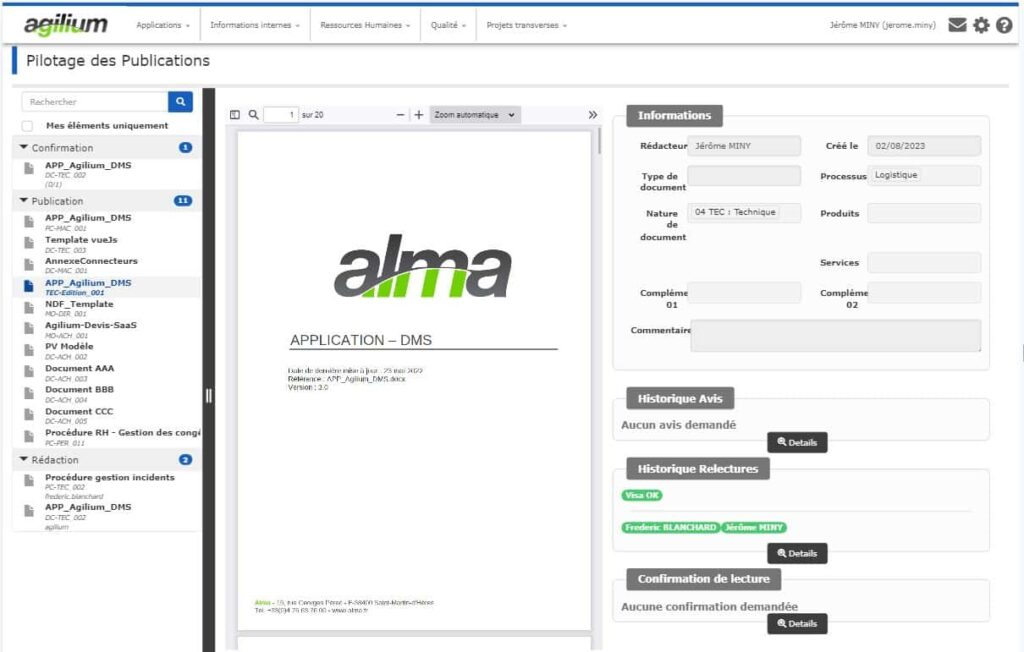
GED, audits, nonconformities, and management: all centralized on a single platform.
Simplified Analysis and Decision-Making
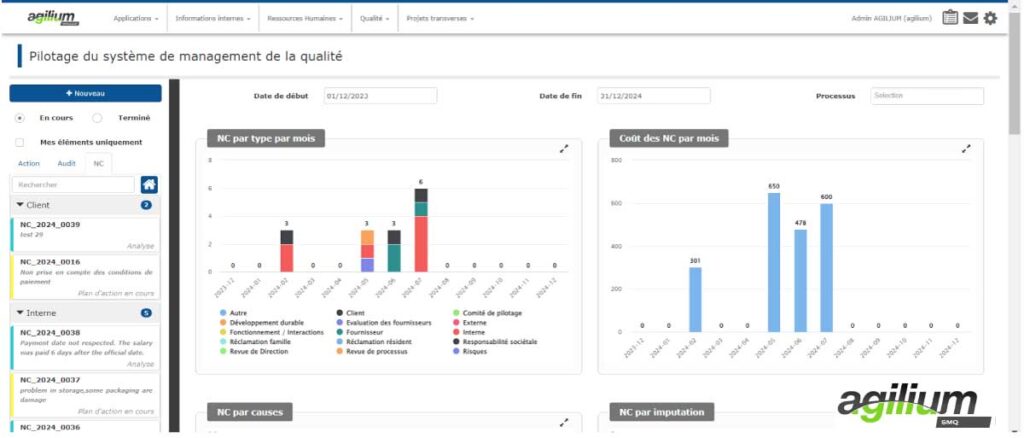
Agilium is now used as a full-fledged database. Every improvement initiative or business process entered into the system feeds into dashboards and visualizations that facilitate reporting and guide analysis and decision-making.
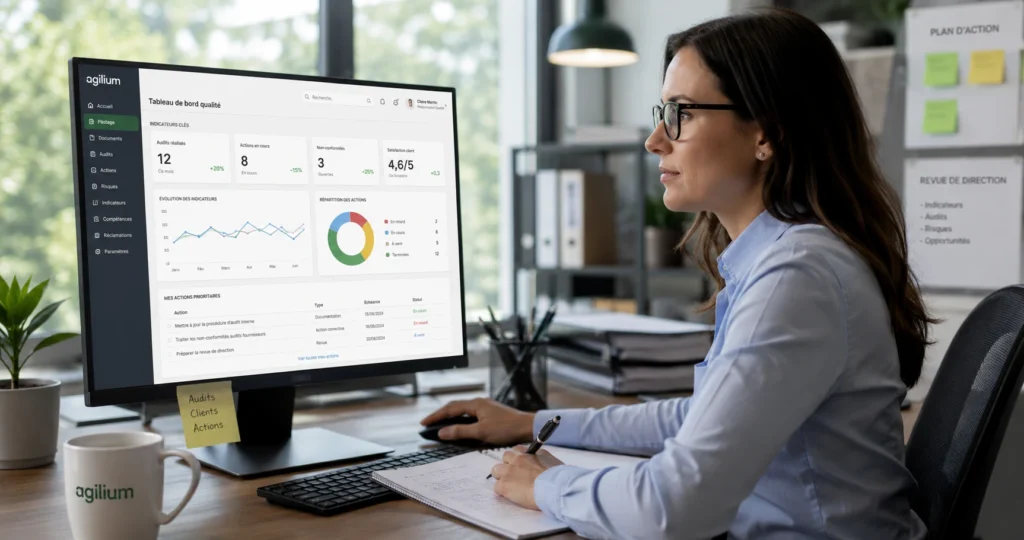
“The tool provides a true visual interpretation of the data: it analyzes, consolidates, and clearly displays the number of actions completed, in progress, or closed, for example. This visual reporting (actions, audits, and nonconformities), which is specific to managing a QMS, is one of the major benefits I find in my day-to-day work.”
The analysis is automated, which is what makes the tool so useful: I have an action plan with 50 tasks, and at a glance I can see that 20 are in progress and 30 are completed… And most importantly, the tool offers reminders and email notifications, which makes it easier to track progress and helps users avoid overlooking tasks.”
Process Mapping, University-Style
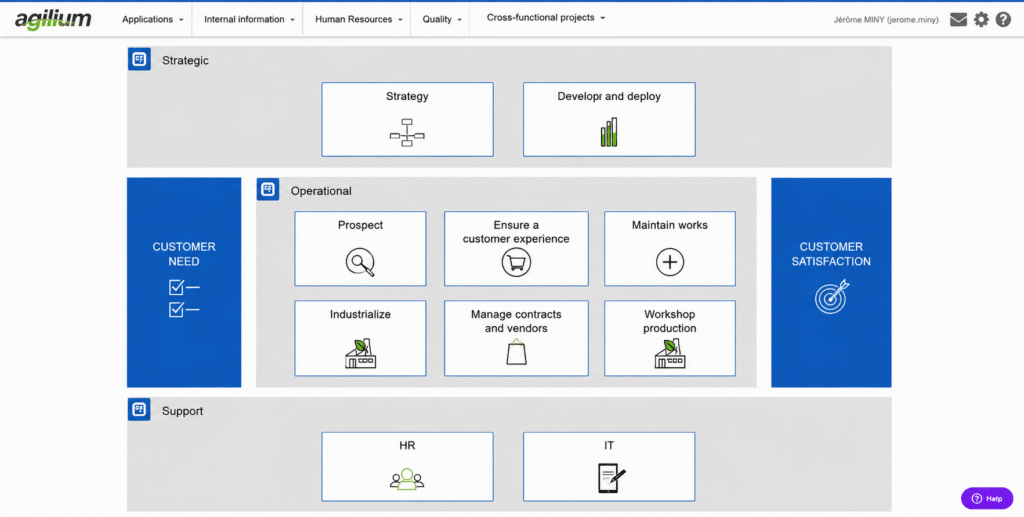
UPEC has its own process map and has broken it down into several levels:
- At the school level,
- At the entity level,
- At the business domain level.
This dual functional and structural approach is particularly relevant in an academic setting, where the diversity of disciplines requires a clear and shared understanding of our activities.
“We’ve approached process mapping from different angles to make it easier for everyone to understand. This allows everyone to see where they fit within the various environments outlined (central departments, shared services, business units, and laboratories), and it’s true that the tool offers this flexibility.”
Ms. Matecki is already planning to add—on her own, using the “drag-and-drop” interface—an additional tile dedicated to “business functions.”
“With just one click, I can view all the processes related to the role of enrollment manager, for example” — Sylvie Matecki, known as Materklas
Adoption and Ease of Use
Agilium has proven to be user-friendly and simple enough to be used by the public sector and public officials with a variety of job roles. The solution helps foster a culture of quality that is well-known and shared by all.
“It’s user-friendly, not too complex… it meets our specific needs for managing a QMS, both for certifications we’ve already obtained and those we’re in the process of obtaining.” — Sylvie Matecki, known as Materklas
The tool integrates seamlessly into the work environment of quality professionals at UPEC and facilitates institutional oversight—for which I am responsible—across all units (faculties, schools, laboratories, central and shared services).
Results Obtained
Currently, 39 users are using Agilium. The main benefits are:
- Enhanced traceability of quality initiatives carried out within the organization (such as internal and external audits)
- Documentation of existing and future quality initiatives (historical record-keeping).
- Automated management ( action plans, processes, audits, document management systems, continuous improvement, process mapping)
“We now share a common foundation of knowledge: everyone is familiar with the range of quality initiatives at UPEC, which makes it easier to share best practices and information.”
New Applications on the Horizon: The Performance Aspect
UPEC plans to expand the use of Agilium to include the risk management (risk oversight and management) features offered by the platform and to strengthen quality management (quality dashboards and oversight of quality committees). The goal is to gain a comprehensive view of the institution’s performance specifically related to its quality initiatives.
Would you recommend Agilium to other interested universities?
“I would recommend it, yes. The flexibility of the configuration is a real asset, even if it requires a significant initial investment from the project team. The Agilium software enables effective management of the QMS (actions, audits, and nonconformities); everything is documented and kept up to date, and the real-time visual reporting is a real plus.”
Like any transformation project, implementing quality management software at a university can raise a number of questions. Certain concerns come up frequently at institutions of higher education: the cost of the project, staff adaptation, the duration of the rollout, and resistance to change.
Thanks to Agilium’s approach, these issues were anticipated and turned into drivers of success:
- Implementation time is kept under control through structured support and a phased rollout by scope (pilot phase, followed by full-scale implementation).
A measurable return on investment, particularly through reduced time spent consolidating metrics, the elimination of duplicate data, and improved tracking of actions.
Seamless integration with existing systems (SharePoint, office software, internal databases) to ensure there is no disruption to team workflows.
Training and change management support, including sessions tailored to each role (administrative staff, faculty, laboratory staff) to foster buy-in.
Conclusion
Thanks to Agilium, UPEC has reached a milestone in the digitization of its quality management system: enhanced traceability, cross-functional collaboration, automation of action plans, and process mapping tailored to the complexities of higher education. The project illustrates how an accessible tool, backed by strong support, can bring about lasting transformation in quality management in higher education.
“It’s very pleasant to work with you—you’re open and responsive, and the tool remains useful and simple. I appreciate that you listen to feedback from the field and are willing to adapt the solution, which allows me to move exactly in the direction I want to manage quality at the university.” — Sylvie Matecki Dit Materklas
“We now share a common foundation of knowledge: everyone is familiar with the range of quality initiatives at UPEC, which makes it easier to share best practices and information.”
- EDM
- CONTINUOUS IMPROVEMENT
“Agilium is a powerful tool for managing our institutional quality management system—and much more. It allows us to capitalize on information and deliverables; to generate visual reports; and, above all, to bring staff and departments together around a single tool dedicated to our quality initiative.”